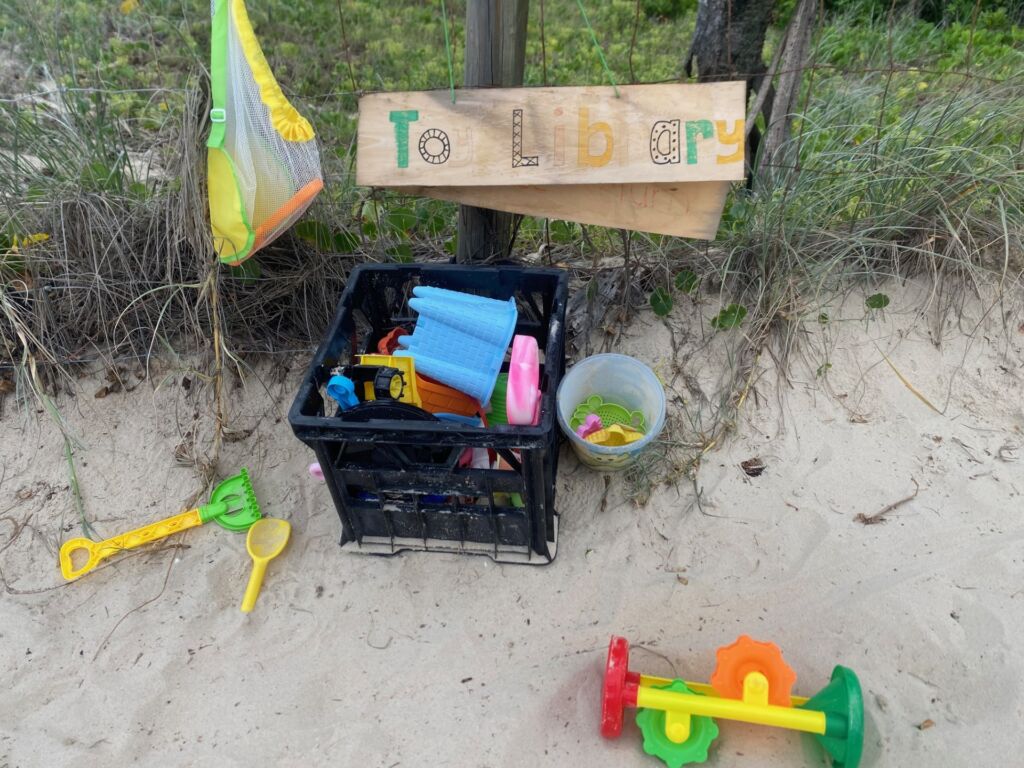
A few months ago, I noticed something small but beautiful at my local beach in Tugun. Tucked beside one of the dune paths was a single milk crate filled with a handful of sandy, sun‑bleached beach toys – some buckets, spades, a little truck missing a wheel. A simple sign with no rules or instructions, just a quiet invitation: borrow, play, return when you’re done.
Since then, that little crate has grown into something much bigger. One crate became two. Then three. Now, several beach accesses have their own overflowing “toy libraries,” each one added to, cared for, and enjoyed by locals and visitors alike.
Every time I walk past, I feel a small lift inside – a sense of belonging, pride, and gratitude for the people who make up this community. I see the same reaction in others: kids racing toward the crates, parents smiling at the unexpected generosity, visitors pausing to take it in. It’s a simple thing, but it changes the energy of the beach. It reminds us that we live among people who care.
And that’s the quiet power of community.
Why Community Matters for Our Health
We often think of health as something individual – our habits, our choices, our biology. But decades of research tell a different story: connection is one of the strongest lifestyle health predictors of physical and mental wellbeing.
Studies consistently show that people with strong social ties experience:
- Lower stress and inflammation
- Better immune function
- Reduced risk of depression and anxiety
- Greater resilience during illness or recovery
- Longer life expectancy
Even small, everyday interactions – like a shared smile, a borrowed toy, or a moment of kindness – can shift our mood and sense of safety.
The World Health Organization’s 2025 report on loneliness highlights just how important this is. Loneliness is now recognised as a significant global health concern, increasing the risk of cardiovascular disease, cognitive decline, mental health challenges, and early mortality. It affects people across all ages and backgrounds, with 1 in 6 people now reporting loneliness.
In a world where loneliness is rising, community moments like the Tugun toy library aren’t just heartwarming – they’re protective. They remind us that we’re part of something bigger, that generosity still exists, and that connection doesn’t always require words.
How to Build Connection as an Everyday Lifestyle Health Habit
As part of our SEEDS and Lifestyle Health Coaching programs, we often explore social connection in depth – completing personalised screening and reflection to help identify what good social connection looks like each individual. What we often find is that building connection and community doesn’t have to mean big gatherings or formal groups. Often, it grows from tiny, human gestures.
Here are some gentle ways to nurture connection:
1. Practice small acts of kindness
Leave something for someone else to enjoy. Offer help. Share a compliment. These micro‑moments create ripples.
2. Engage in shared spaces
Parks, beaches, libraries, community gardens—these places naturally invite connection, even if it’s just a smile or a shared moment.
3. Contribute in small ways
Add a toy to the beach crate. Pick up a piece of rubbish. Water a community plant. Contribution builds belonging.
4. Notice and appreciate others
A simple “thanks,” “good morning,” or “I love what you’ve created here” strengthens the invisible threads between people.
5. Let yourself receive
Borrow the toy. Accept the help. Take the kindness offered. Connection flows both ways.
A Final Thought
The Tugun toy library didn’t appear because someone launched a community initiative. It grew because people quietly cared. One person left a toy. Another added one. Someone else tidied the crate. Over time, a small act became a shared symbol of generosity and connection.
Community doesn’t always look like organised events or big social circles. Sometimes it looks like a milk crate full of sandy toys, reminding us that we’re surrounded by people who want to make life a little lighter for one another.
And in a world where loneliness is becoming more common, these small, human gestures matter more than ever.